Strigarum Arcana
The Tarot of the Witches
The Untamed Vertigo of Being
The Tarot of the Witches
The Untamed Vertigo of Being
English Translation
01 — STRUCTURE OF THE TAROT
A Tarot deck consists of 78 cards: 22 Major Arcana and 56 Minor Arcana, divided into the four suits of Cups, Wands, Swords and Coins.
Traditionally, the four suits have been associated with the orders of medieval society: Cups with the clergy, Wands with those who worked the land, Swords with the warrior class, and Coins with merchants and economic activity.
In French-suited playing cards, these suits became Hearts for Cups, Clubs for Wands, Spades for Swords and Diamonds for Coins: suits that later became the international standard for poker decks.
The 56 cards now known as the Minor Arcana consist of forty numbered cards, from Ace to Ten, and sixteen Court Cards — Page, Knight, Queen and King.
The remaining 22 cards are the Triumphs, now known as the Major Arcana: allegorical figures, virtues, powers and conditions of human experience.
The Tarot originated in Italy in the fifteenth century as a card game and, over time, also became a system of images through which to explore human experience.
Strigarum Arcana preserves the traditional structure of the Tarot while reinterpreting its language through the figure of the Witch. Not a fantastical creature, but an image of the individual seeking to free themselves from the conditioning and constructs that limit their identity.
The 78 works thus form a single symbolic journey, in which desire, will, conflict, awareness and matter become instruments through which to explore the human condition.
DID YOU KNOW?
The common Italian 40-card deck retains, for each suit, the Ace, cards 2 through 7, and three court cards: Page, Knight and King. The Queen is absent.
The international 52-card deck, also used for poker, instead retains the cards from Ace to Ten and includes Page, Queen and King: it is the Knight that is absent.
02 — FOUR SUITS, ONE JOURNEY
In the Minor Arcana, the four suits preserve the meanings and functions that tradition has progressively attributed to them. In Strigarum Arcana, we have chosen to highlight, through their relationship with one another, four fundamental dimensions of experience: nurturing one’s inner life, recognising and setting the will in motion, developing awareness and discernment, and finally transforming one’s possibilities into concrete experience.
This is not intended to introduce a new hierarchy among the suits, but to make visible one possible path already contained within their symbolic qualities: Cups, Wands, Swords and Coins thus become four complementary ways of moving through life.
CUPS — FILLING THE INNER VOID
The realm of feeling: desire, relationships, memory, loss, fulfilment and harmony.
The realm of feeling: desire, relationships, memory, loss, fulfilment and harmony.
WANDS — THE SPROUT OF WILL
The force of will: impulse, movement, assertion, endurance and limitation.
The force of will: impulse, movement, assertion, endurance and limitation.
SWORDS — BECOMING AWARE OF THE TRUTH
The realm of mind and discernment: choice, conflict, separation, clarity and destiny.
The realm of mind and discernment: choice, conflict, separation, clarity and destiny.
COINS — MAKING TALENTS BEAR FRUIT
Our relationship with the material world: work, resources, exchange, waiting, security and legacy.
Our relationship with the material world: work, resources, exchange, waiting, security and legacy.
The four suits do not describe a hierarchy, but complementary forces of experience: what we feel, what we want, what we understand, and what we are able to transform into reality.
03 — THE COURT CARDS
In the Tarot tradition, the Court Cards embody different ways of expressing the qualities of their respective suit. In Strigarum Arcana, this structure also becomes a narrative progression.
PAGE — THE NOVICE WITCH
She is the apprentice: she discovers the principle of the suit, observes it and begins to experience it.
The Novice wears the chiton; her journey is not yet complete.
She is the apprentice: she discovers the principle of the suit, observes it and begins to experience it.
The Novice wears the chiton; her journey is not yet complete.
KNIGHT — THE WITCH IN ACTION
What the Novice has encountered is set in motion. The Knight transforms possibility, desire, thought or resource into action.
What the Novice has encountered is set in motion. The Knight transforms possibility, desire, thought or resource into action.
QUEEN — THE QUEEN OF THE WITCHES
She represents a mature and conscious relationship with the suit: she knows its power without being dominated by it.
She represents a mature and conscious relationship with the suit: she knows its power without being dominated by it.
KING — THE KING OF MEN
The King of Men, and not of the Witches, instead reveals the shadow side of the suit. In Strigarum Arcana, the King deliberately assumes the meanings that tradition often associates with the reversed card.
The King of Men, and not of the Witches, instead reveals the shadow side of the suit. In Strigarum Arcana, the King deliberately assumes the meanings that tradition often associates with the reversed card.
Across all the Courts, the female figures represent different stages in the Witch’s journey; the male figures, depicted as skeletons, instead assume the role of a critical counterpart to power.
04 — THE VISUAL LANGUAGE
Colour, position, gesture, metal and word do not form a code to be deciphered mechanically. They create a visual grammar: each card combines these elements to guide meaning without exhausting it.
IMAGE AND SYMBOL
In the numbered cards, meaning arises above all from the arrangement of the elements: balance, opposition, repetition, distance and movement.
The image does not tell a scene, but constructs a semiotic relationship between symbols.
In the Major Arcana, by contrast, metaphorical and narrative representation prevails: the Witch moves through situations, figures and archetypes that visually translate the human condition.
THE WITCH AND THE BODY
The Witches do not depict real bodies, but the soul laid bare, as it frees itself from the roles, conventions and constructs through which it is defined and judged. The body thus becomes an essential form.
The Novice Witch has only just begun her journey. Freeing the mind from what we have learned, from expectations and from the images constructed of ourselves is not an immediate act: it may take an entire lifetime. Her clothing tells this story too: its drapery recalls the solidity of Doric columns, a temple difficult to bring down, but whose fall is necessary in order to progress.
All the male figures — King, Pope and Emperor — instead embody power when it hardens into role, dogma and law. For this reason they take the form of skeletons: authority rendered sterile by its own rigidity. This is not a contrast between genders, but between inner freedom and an identity constructed through power.
Death, by contrast, is not a skeleton: she is the great Lady who accompanies souls in their passage between the earthly world and the world beyond.
05 — THE VISUAL LANGUAGE
COLOUR AND METAL
White, black and red form the chromatic structure of the deck. The palette is deliberately reduced to these three elements — even though, strictly speaking, red is the only actual colour — because of the strength of their archetypal symbolism: white is light, black is darkness, and red represents human drives and passions, capable of pushing the individual beyond their limits.
Gold and silver leaf introduce a further level of meaning: they highlight what, within the composition, assumes a particular, active or dominant role. Gold prevails in Cups and Coins; silver in Wands and Swords.
In the Major Arcana, metallic leaf accompanies and reinforces the metaphorical construction of the card, bringing out the elements that are decisive to its interpretation.
LATIN
In Strigarum Arcana, Latin is a structural choice. For centuries it was the language of knowledge, classification and ancient scientific notation: to give things a name meant to recognise them, understand them and, in some way, bring them into order.
This same language recurs in formulas, texts on the occult and in the culture that accompanied the ecclesiastical tribunals before which Witches were judged. In Strigarum Arcana, this relationship is symbolically reversed: the language that helped to name, classify and condemn them now returns to give them a voice.
Latin also removes the cards from the language of the present, placing them in a symbolic space suspended in time. The brief formulas do not simply describe the images: they guide their meaning through a single shared language, capable of crossing cultural and linguistic boundaries.
ON CALLIGRAPHY AND THE PRAISE OF ERROR
In an age in which the image seems to strive towards digital perfection, Strigarum Arcana asserts the value of the handmade gesture. Drawing, painting and calligraphy preserve the trace of the hand that produced them: a line may hesitate, ink may spread, porous paper may resist.
Calligraphy therefore does not seek the cold precision of a typeface. Every letter, like every drawing, is born from an unrepeatable gesture. On paper, every mark retains small variations, imperfections and accidents: it is precisely in this distance from perfect execution that the presence of the person who traced it remains.
06 — MAJOR ARCANA
THE WITCH’S JOURNEY
The interpretation of the 22 Major Arcana in Strigarum Arcana draws on and reworks the structure proposed by Oswald Wirth (1860–1943) in Le Tarot des Imagiers du Moyen Âge (1927), which interprets the Triumphs as an initiatory journey articulated between an active dimension and a receptive, contemplative one.
VI and XVII occupy symmetrical positions within the two halves of the journey: both mark a threshold. The first opens the passage from preparation to action; the second, from inner transformation to a new phase of awareness. Their correspondence makes visible the balance between the two great parts of the Major Arcana.
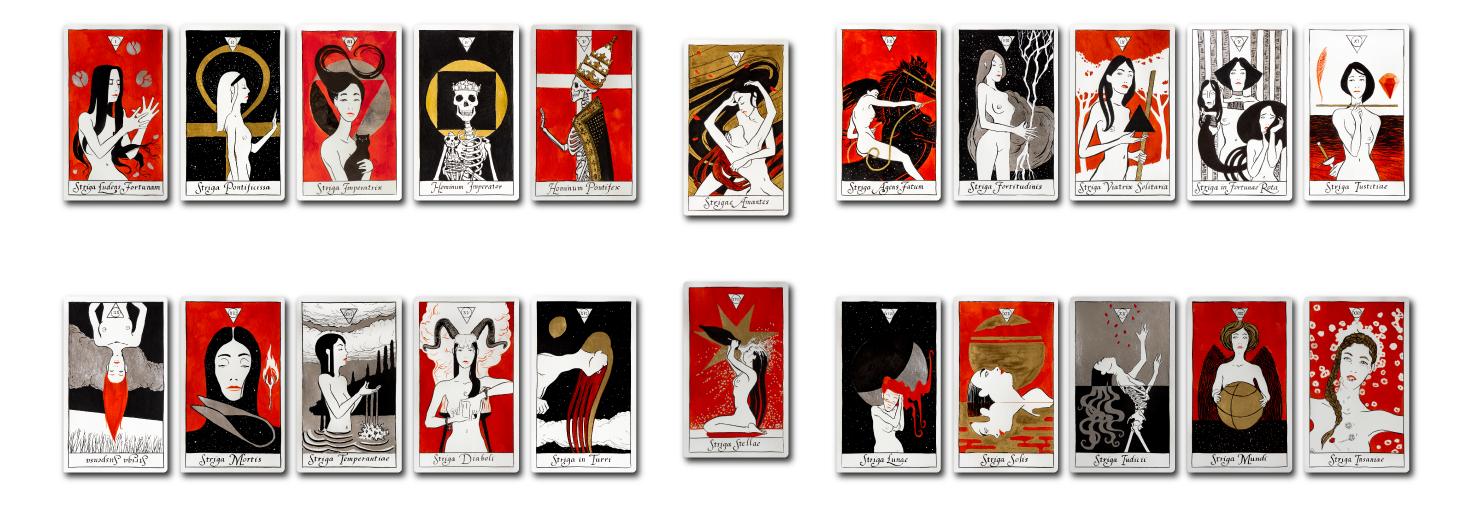
I–II–III–IV–V • KNOW
The first five cards build the individual’s tools: identity, knowledge, thought, order and a relationship with tradition.
VI • CHOOSE
The Lovers mark the threshold: what has been understood must become a choice.
VII–VIII–IX–X–XI • ACT
Will enters the world. Movement, strength, seeking, destiny and justice confront the individual with the consequences of their own actions.
XII–XIII–XIV–XV–XVI • LET GO
Will is no longer enough. Suspension, death, temperance, temptation and crisis open a phase of inner transformation.
XVII • RECEIVE
The Star introduces a different principle: not what the Witch conquers, but what she can receive after passing through transformation.
XVIII–XIX–XX–XXI–XXII • REVEAL
Moon, Sun, Judgement, World and Madness lead through intuition, clarity and fulfilment to the concluding paradox: every ending already contains the possibility of beginning again.
THE DANCE OF OPPOSITES
In Strigarum Arcana, the two halves of the Major Arcana mirror one another through colour as well: red in the first series corresponds to black in the second, and vice versa.
Two cards deliberately escape this rule: VI — The Lovers, dominated by gold — Omnia vincit Amor — and XXII — Madness, the Fool of tradition, which deliberately breaks every rule.
07 — ORACULUM STRIGARUM
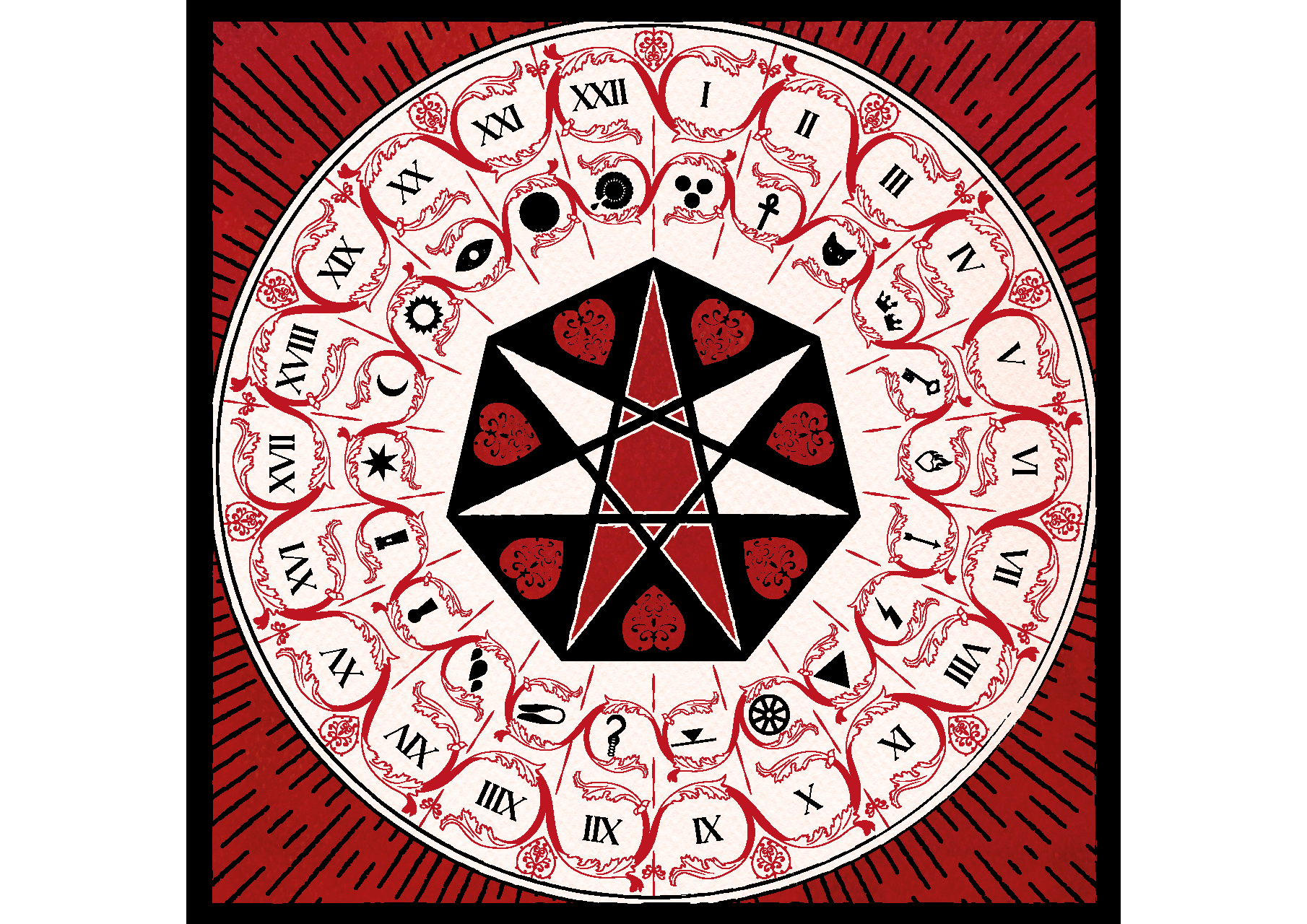
THE ORACLE OF THE WITCHES • CONSULT THE 22 ARCANA
1 — ASK YOUR QUESTION
You are standing before the Oracle of the Witches. Think carefully about what you wish to ask, form the question within yourself, and do not speak it aloud.
2 — SPIN THE WHEEL
Let the Wheel stop on one of the 22 Arcana. Check the arrow: is the card upright or reversed?
3 — FIND THE CARD
Find on the wall the Arcana chosen for you by the Wheel.
4 — LISTEN
Scan the QR code in your language and listen to the meaning of the card.
5 — LET THE IMAGE WORK
Observe the card: what you read in it arises from the encounter between image, words, and what you carry within you.
6 — REMEMBER
The Wheel does not predict the future: it sets a question in motion.
08 — BEYOND THE EXHIBITION
FIVE YEARS OF RESEARCH
Strigarum Arcana is the result of a journey that began five years ago, when the figure of the Witch first entered Ardo Quaranta’s work. From the earliest paintings to the creation of the 78 Arcana, the project gradually developed into a system of images, symbols and relationships.
This exhibition presents the complete work for the first time. But the completion of the 78 images now opens a new phase: transforming Strigarum Arcana into a Tarot deck.
FROM EXHIBITION TO TAROT DECK
Strigarum Arcana will become a complete Tarot deck through a crowdfunding campaign on Kickstarter.
Visit the project website to discover the deck and find out when the campaign goes live.
ARDO QUARANTA
Ardo Quaranta, artist, architect, dreamer and sailor, brings together diverse experiences in a practice that spans painting, drawing, design and symbolic language. His research explores individual identity and the relationship between freedom, conditioning and social construction.
The figure of the Witch runs through his work, from the painting series Streghe Fluttuanti (Floating Witches) to Strigarum Arcana, where this research encounters the historical and symbolic structure of the Tarot. In 2025 he designed Divinissimi Assi, a poker deck created through a crowdfunding campaign and produced by CalamoVe.